Problem Set 2: Attack of the Robots
Due Wednesday, September 19, 2007, 11:00 pm.
- Sep 12: Part 2: An obvious typo has been fixed in the definition
of IMPLIES. Also, the description of the input string for makeTree has been
fixed: variables are in all lowercase, constructor names are in all
uppercase. Changes are shown in red.
Instructions
This problem set has 5 compulsory parts: one written part and four programming
parts.
You will write your solution to each part in a separate file: written.txt, part2.sml,
part3.sml, part4.sml and part5.sml.
To get you started, we have provided a stub file for each
part. You can download and edit these files. Please write your name
and NetID as a comment at the top of each file. Once you have finished, submit your solution using CMS. Remember that code that do not compile automatically receives zero.
We highly recommend you start your work early!
TOP SECRET: RESNET OPERATION #42
And you thought a horde of Zombies attacking Ithaca was disturbing...
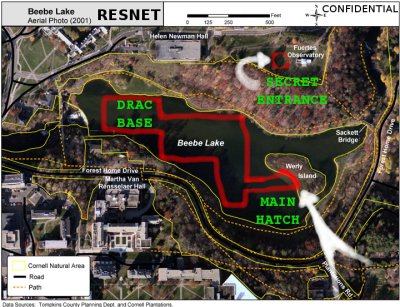 After many years of planning and plotting,
the Department of Robotics at Cornell (DRAC) has decided now is the
take to take over the rest of the Cornell campus.
In a secret laboratory beneath Beebe lake, a group of students and faculty have designed and
engineered countless autonomous robots whose sole goal is to
completely block the access to the most precious energy resource
on campus: Free Food (FF). The army of robots have formed barriers
around all FF sources and will disrupt any unauthorized attempt to
access the FF without any exception.
Fortunately, spies from the underground Resistance Network (RESNET)
have just
uncovered blueprints of the underlying circuitry of all the robots.
In the blueprints, the first thing you notice is
that the robots have a built-in Emergency Shutoff (ES) feature that is
triggered by opening a small panel on the torso of the robot,
and entering the correct bit string.
Unfortunately, the other engineering members of RESNET have concluded
that each robot has distinct circuitry, and thus a distinct ES code.
Also, there seems to be no way to invert the circuit to see what the
code is, so it needs to be cracked by trying all possibilities.
Even worse, if the panel
on a robot is opened, and the correct code is not entered within
5 seconds, the robot will stun the person entering
the code, and alert all other robots to ignore any Emergency Shutoff
request for the next 48 hours!
After many years of planning and plotting,
the Department of Robotics at Cornell (DRAC) has decided now is the
take to take over the rest of the Cornell campus.
In a secret laboratory beneath Beebe lake, a group of students and faculty have designed and
engineered countless autonomous robots whose sole goal is to
completely block the access to the most precious energy resource
on campus: Free Food (FF). The army of robots have formed barriers
around all FF sources and will disrupt any unauthorized attempt to
access the FF without any exception.
Fortunately, spies from the underground Resistance Network (RESNET)
have just
uncovered blueprints of the underlying circuitry of all the robots.
In the blueprints, the first thing you notice is
that the robots have a built-in Emergency Shutoff (ES) feature that is
triggered by opening a small panel on the torso of the robot,
and entering the correct bit string.
Unfortunately, the other engineering members of RESNET have concluded
that each robot has distinct circuitry, and thus a distinct ES code.
Also, there seems to be no way to invert the circuit to see what the
code is, so it needs to be cracked by trying all possibilities.
Even worse, if the panel
on a robot is opened, and the correct code is not entered within
5 seconds, the robot will stun the person entering
the code, and alert all other robots to ignore any Emergency Shutoff
request for the next 48 hours!
The most recent development is that
RESNET has just learned that each robot has a unique identifier on the
panel that is only visible after the panel has been
opened (an unnamed professor went through a lot of trouble to
discover this the hard way when he attemped to secure a slice of pizza
at a seminar). The great news is that the same identifier appears on the
blueprints.
Thus it should be possible to
- Bravely walk up to a robot
- Open the panel and read the ID
- Find the blueprint of that particular robot
- Crack the code of the ES circuit
- Enter the code, cross fingers, and disable this robot.
- Repeat for all other robots surrounding the FF source.
The problem is that until we open the panel, we have no idea
which robot is which, and cracking the ES code certainly takes longer
than 5 seconds.
As an invaluable CS expert in RESNET, you immediately see
that the most direct approach is to reverse-engineer and crack all
of the ES circuits before opening any panels. There are too many robots
and blueprints to do this manually, so you decide to write a program to do the
cracking. Given the situation, the natural choice for a programming
language for this task is ML.
Time is running out. It is in your hands to regain control over the FF
supplies, and save the whole campus!
Part 1: Evaluation using substitutions
As you sit down, you suddenly realize the severity of the situation.
You get a little nervous since most of the ML code you've written ended up
having occasional mistakes, and there is really no room for errors
this time. You decide that it makes sense to start off by writing
down things that you feel you need to fully understand before being
able to undertake the RESNET Operation with full confidence.
You grab a piece of paper and write down some non-trivial expressions,
and start seeing how they evaluate, step by step. On the paper you write
(fn x => fn y => x * y * (fn y => y+x) 10) 3 8
let
   val x = 2 + 3
   val y = fn z => z+1
   val z = y x
in
   (fn x => x*z) (y z)
end
let
   val l = [ [7,8,9], nil ]
in
   case l of
      (x1 :: x2 :: xs) :: nil => x1 + x2
    | (x1 :: x2 :: xs) :: [nil] => x1 + x1 + x2
    | (x1 :: x2 :: xs) :: xt => x1 + x2 + x2
    | _ => 0
end
To do: Write the evaluation of these expressions using small-step substitutions
in a file called written.txt
Part 2: Parsing postfix
[
Download stub file: part2.sml ]
A few experiments later, you again feel confident in your ML skills.
It is time to start addressing the real problems at hand. You look
at the blueprints again. It appears the DRAC engineers designed the ES circuits
to use the following set of gates.
AND: x AND y = true iff both x and y are true.
OR: x OR y = true iff either x or y are true.
NOT: NOT changes true to false, and vice versa.
XOR: x XOR y = true iff exactly one of x and y are true
NAND: x AND y = true unless both x and y are true.
IMPLIES: x IMPLIES y = true unless x =
true and y =
false.
You write the code to make use of the following datatype.
datatype CircuitTree =  AND of CircuitTree*CircuitTree | OR of CircuitTree*CircuitTree |
                        XOR of CircuitTree*CircuitTree | NAND of CircuitTree*CircuitTree |
                        IMPLIES of CircuitTree*CircuitTree | NOT of CircuitTree |
                        Var of string
where Var is just the name of the variable.
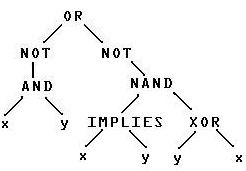 First step is to manually read off the circuit from the blueprint and
input it into your program. To make this easier, the fellow RESNET
engineers have spent hours deciphering and writing up each circuit
in postfix form. (They picked postfix notation because infix is ambiguous without
loads and loads of brackets).
Thus, the postfix form of the expression tree in the right is:
First step is to manually read off the circuit from the blueprint and
input it into your program. To make this easier, the fellow RESNET
engineers have spent hours deciphering and writing up each circuit
in postfix form. (They picked postfix notation because infix is ambiguous without
loads and loads of brackets).
Thus, the postfix form of the expression tree in the right is:
"x y AND NOT x y IMPLIES y x XOR NAND NOT OR"
You need to build the ML data structure that represents the actual expression
tree, that is:
NOT (Var "x" AND Var "y") OR NOT ((Var "x" IMPLIES Var "y") NAND (Var "y" XOR Var "x"))
[this expression was wrong originally; it was corrected on 9/08]
You write a function
fun makeTree(circuit : string) : CircuitTree
that translates a given circuit written in postfix form to a CircuitTree.
The postfix form is a string with whitespace delimiters,
variables in all lowercase, and keywords (representing datatype constructor
names) in all uppercase.
Just to be on the safe side, you are aware that the engineers could have
made mistakes during the typing up, so that if the input doesn't make
sense -- for example "x IMPLIES" or "NOT NOT NOT"
-- makeTree should raise Fail. You can never be too careful.
To do: Implement makeTree in
part2.sml
Part 3: Evaluating circuit trees
[
Download stub file: part3.sml ]
Like a professional cryptanalyst, you want to get a feel for
the circuits to look for possible weaknesses before you start cracking
the ES codes. To do that, you want to be able to provide input
codes to the circuits. More specifically, given a map from variables to their
values represented as an association list (i.e., a list of variable
names and input value pairs),
evaluate the output of the
circuit. The function you write is
fun evaluate(circuit : CircuitTree, values : BitValue list) : bool
where
type BitValue = string * bool
For example, the list of values could be [("x", true), ("y", true), ("z", false)].
To make this easier, you decide to write another function to help
look up variable names from the list of assignments. You call it
fun findValue(name : string, values : BitValue list) : bool
It is critical that every single ES code is cracked correctly,
so you want minimize the margin for errors. It is possible that the
engineers made errors while translating the blueprint specs
into the postfix notation (after all they're very hungry). Thus if
findValue does not find a variable name in the association list,
it is important that the function raise a Fail exception.
To do: Implement evaluate and findValue in
part3.sml.
Part 4: Tree reduction
[
Download stub file: part4.sml ]
Now that you have a better feel for how the circuits operate, the next step is
to write the cracker. To simplify things before starting the cracking, you decide to
reduce the number of gate types in the circuit. For instance, (ignoring the ML datatype for clarity)
x NAND y is equivalent to NOT (x AND y). Similarly,
x XOR y becomes (x AND NOT y) OR ((NOT x) AND y), and
x IMPLIES y is really (NOT x) OR y.
To this end, you write a routine
fun simplifyGates(circuit : CircuitTree) : CircuitTree
to convert the original circuit tree into a simpler form
that only uses the AND, OR and NOT gates.
A friend of yours points out that it would be extremely helpful to implement
a "fold" routine for the tree structure you defined that works similar to foldl and foldr.
Following her suggestion, you write:
fun foldTree (f : (CircuitTree * 'a) -> 'a) (a : 'a) (t : CircuitTree) : 'a
and exploit it in your simplifyGates function.
[Looking back at your ML code so far, you wonder how on earth you would have pulled
this off in say Java.]
To do: Implement simplifyGates and foldTree in
part4.sml. Make use of foldTree in simplifyGates.
Part 5: Cracking!
[
Download stub file: part5.sml ]
You continue playing around with the simplification of the ES circuits,
and actually putting them on a normal form, similar to the one you
saw in complexity that was used for 3-SAT expressions. It turns out
that the DRAC engineers are no weenies - to crack the circuits you
are actually required to solve an instance of an NP-complete problem!
The only algorithms that are known for solving 3-SAT are exponential in the
input length. In other words, it would probably have been impossible to do
the cracking in the 5 second grace period given by a robot, so the DRAC
people must have some sort of book with robot IDs and the ES code for each
robot. With luck, you will be able to replicate those codes!
Your first observation is that the circuits are not impossibly big, so that
even exponential algorithms will terminate before our sun contracts into itself.
After all, the DRAC engineers probably had to something similar to come up
with those codes.
The second observation is that there is nothing in the way for there being
multiple codes that work for a given robot. No distinction appears to be
made in the ES circuits, so any solution will do.
Up to this point, it has been your hope that it would be possible to narrow down
the set of potential ES codes for each circuit to something that would be straightforward
to crack. Something like "bits 2 and 4 need to be set, and the last 3 bits
need to be the same value" would have been great. But this does not seem feasible
anymore, so we're going to have to resort to trying all possible inputs for the
circuit. You're going to use the simplified CircuitTrees from the last part.
This is it. Your heartbeat is up. Your pupils are dilated,
Your fingers are itching. It's time to start cracking. You grab the keyboard
and type
(* VIVA RESNET!!! *)
fun crack(circuit : CircuitTree, variables : string list) : BitValue list
with the mental note that variables is the list of literals that appear in the
circuit, and that the function should return truth assignments to those variables
that will cause the circuit to evaluate to true. These truth assignments are
in turn the code to the robot! Suppose robot #2718 had only 4 bits in the code
on its panel. The hope is that something like
crack (simplifyGates (circuit2718), ["b1", "b2", "b3", "b4"])
will return a list like
[("b1", true), ("b2", false), ("b3", false), ("b4", true)]
so that entering 1001 on the panel will activate the Emergency Shutdown feature.
Since the robots all have longer codes that 4 bits, the cracking could take a while.
Cross your fingers... the future of the campus is in your hands!
To do: Implement crack in
part5.sml